

The 24-hour Holter monitor is an ambulatory cardiac study that continuously records every heartbeat for a full day while you go about your daily activities. Unlike the office electrocardiogram that captures only a few seconds of electrical activity, the Holter analyzes more than 100,000 beats in 24 hours, making it the most effective tool for detecting intermittent arrhythmias that could go completely unnoticed on a conventional ECG.
What is a Holter monitor and how does it work
The Holter monitor is a portable device roughly the size of a cell phone that connects to the patient's chest via three to five adhesive electrodes. The device continuously records cardiac electrical activity and stores the data in internal memory. At the end of the monitoring period, the cardiologist downloads the information and analyzes it with specialized software that automatically identifies rhythm disturbances, pauses, tachycardias, and other relevant findings. The name comes from its inventor, biophysicist Norman J. Holter, who developed this technology in the 1960s.
Indications: who needs a Holter monitor
Your cardiologist may order Holter monitoring when the standard electrocardiogram is not sufficient to clarify the diagnosis. The most common situations include:
- ●Recurrent palpitations that do not occur during the office visit and are not captured on the resting ECG
- ●Episodes of dizziness, vertigo, or fainting (syncope) whose cause has not been determined
- ●Evaluation and follow-up of previously diagnosed arrhythmias such as paroxysmal atrial fibrillation
- ●Monitoring the effectiveness of anti-arrhythmic medications or beta-blockers
- ●Post-heart-attack or post-cardiac-surgery assessment to detect recovery arrhythmias
- ●Investigation of atypical chest pain that may be related to rhythm disturbances
- ●Verification of correct pacemaker function in patients with implanted devices
- ●Evaluation of chronic fatigue or exercise intolerance with suspected cardiac origin
Preparation before Holter placement
Preparation is straightforward, but there are key aspects to consider for an optimal quality recording:
- ●Shower and thoroughly wash the chest area before your appointment, as you will not be able to get wet during the 24-hour study
- ●Do not apply creams, oils, lotions, or perfume to the torso; these substances weaken electrode adhesion
- ●Wear comfortable, loose-fitting clothing, preferably cotton, that can discreetly conceal the device
- ●Take your usual medications normally unless the cardiologist instructs otherwise
- ●Prepare comfortable sleepwear that does not press against the monitor cables
What you can and cannot do during monitoring
Once the Holter is placed, the goal is for you to live as normally as possible so the recording reflects real-life situations:
- ●You can and should carry on with your daily activities: work, walk, climb stairs, do moderate exercise, eat, and sleep as usual
- ●Each time you feel a symptom (palpitations, dizziness, chest pain, shortness of breath), press the event button on the device and note in the diary we provide the exact time, symptom, and activity you were performing
- ●You cannot shower, bathe, swim, or be exposed to rain; the device is not water-resistant
- ●Avoid electric blankets, airport metal detectors, and appliances that generate strong electromagnetic fields
- ●Sleep in whatever position is most comfortable; the device is small enough not to significantly interfere with sleep
How Holter results are interpreted
Specialized software processes the more than 100,000 recorded beats and generates a detailed report that the cardiologist reviews manually. Key parameters analyzed include:
- ●Minimum, maximum, and average heart rate during day and night, as well as heart rate variability
- ●Detection of sustained or paroxysmal arrhythmias: atrial fibrillation, atrial flutter, supraventricular or ventricular tachycardias
- ●Count and classification of atrial and ventricular premature beats, determining whether they occur in isolation, in pairs, or in runs
- ●Identification of significant cardiac pauses, meaning intervals where the heart takes longer than normal to generate the next beat
- ●Clinical correlation between symptoms the patient recorded in the diary and electrical findings at that precise moment on the tracing
- ●ST segment changes that may suggest episodes of silent myocardial ischemia
Difference between a 24-hour Holter and an event monitor
The 24-hour Holter records continuously for one or two full days. If your symptoms are frequent (at least once daily), the Holter is usually sufficient to capture the event. However, if episodes are sporadic and occur every week or month, the cardiologist may order an event monitor worn for longer periods (14 to 30 days) that records only when the patient activates the device upon feeling symptoms.
The 24-hour Holter monitor is safe, painless, and does not interfere with your daily routine. It is the most powerful tool for uncovering hidden arrhythmias that an office ECG cannot catch. At ElderCardio, Dr. Jimenez Iglesias personally analyzes every Holter recording. Schedule your appointment at (998) 116-3657.
Holter monitoring in Cancun
At Dr. Elders Jimenez Iglesias's office in Hospital Galenia, Office 403-A, Tower B, Hotel Zone in Cancun, we perform 24-hour Holter monitoring with high-resolution digital equipment. Placement and removal are done at the office, and results are personally interpreted by the specialist cardiologist to provide you with an accurate diagnosis and a clear action plan.
Disclaimer: This article is for informational purposes only and does not replace professional medical consultation. Always consult a qualified cardiologist for diagnosis and treatment of heart conditions.
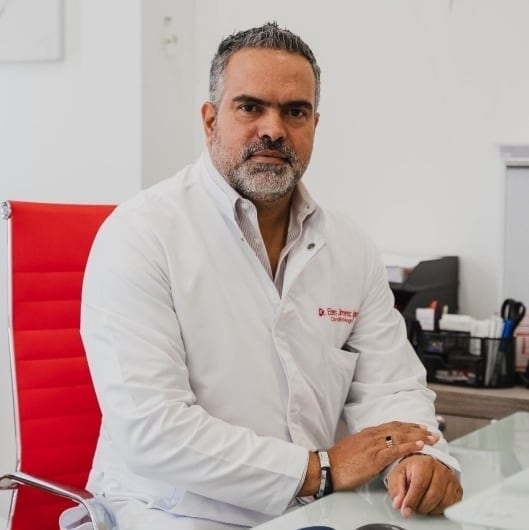
Dr. Elders Jimenez Iglesias
Cardiologist · Nuclear Cardiology
Professional License: 13819257 · Specialty: 12543211
Have questions about your heart health?
Schedule a personalized evaluation with Dr. Jimenez. Board-certified cardiologist with expertise in nuclear cardiology.